
Two Separate Agreements: The Professors of Digital Health and Care Wales
Three of Digital Health and Care Wales's executive directors hold 'Professor of Practice' titles from the university that is also their organisation's landlord and training partner. The chief executive's title was announced at an event where the university was represented by her former NWIS colleague, who later presented the other two. Nobody has declared any of it. Asked what the professors have done, the university gave two incompatible answers in seven days — and then renewed the titles.
5 October 2026 · 36 min read
On 9 December 2020, at an online event, the University of Wales Trinity Saint David (UWTSD) named two people from the NHS Wales Informatics Service (NWIS) Professors of Practice. One was Helen Thomas, NWIS's Director of Information from 2017 and by then its interim director, who four months later would become founding chief executive of the body that replaced it, Digital Health and Care Wales (DHCW). The other was Andrew Griffiths, who had led NWIS as its director and chief information officer until December 2019 and was by then chair and chief executive of the Federation for Informatics Professionals (FEDIP) — the professional body that registered Thomas as a Leading Practitioner.
On the university's side of the screen sat their former NWIS colleague. Wendy Dearing had been NWIS's Head of Workforce and Organisational Development, and had helped build the partnership the event was celebrating: the Wales Institute of Digital Information (WIDI), launched by NWIS and UWTSD in 2017. While still at NWIS she had been given a UWTSD professorship of her own. "As a result" of the partnership, she later wrote, "I proudly accepted" it. She, too, is a FEDIP Leading Practitioner, and in January 2020, as a FEDIP board member, she had welcomed Griffiths's appointment as its chief executive. On 17 September 2020 UWTSD announced her as the new head of its Institute of Management and Health. Less than three months later, as head of that institute and a director of WIDI, she was presenting the partnership's work at the event where Thomas and Griffiths were named.
In March 2024 it was Dearing, by then the institute's Dean, who handed certificates to two more DHCW executive directors, Professors of Practice since the previous November by their own account: Rhidian Hurle, the medical director, and Ifan Evans, the director of strategy. Every holder in this story, Dearing included, has held a senior post at NWIS or at the body that replaced it. Formally, UWTSD says, its titles are approved by Senate and Council, though it has produced no minute recording any of these.
At the 2020 event Thomas also signed, for NWIS, a memorandum bringing the University of South Wales into WIDI. On 1 April 2021 NWIS was dissolved into DHCW, which took over its people, its systems, its partnerships and its lease in UWTSD's Swansea building. All three DHCW titles are still held. In July 2026 the university confirmed it had renewed them.
This article is not about fake titles. The titles are real, and UWTSD is entitled to award them. It asks what the title is, what the university can say about it, what passed between the university and DHCW while three of DHCW's directors held it — and what DHCW's registers, accounts and board meetings record about any of that. The answer to the last question is: nothing.
What the title is
"Professor" is not a protected title in the United Kingdom. Universities make their own rules, and they differ sharply. Imperial College London, for instance, does not permit its Professors of Practice to write "Professor" before their names.
UWTSD's description of the title, as published when a Hywel Dda clinician received it, is that it is "bestowed upon an individual to honour and recognise that person for having attained academic and/or professional distinction in those disciplines, which are aligned with the strategic intentions of the University." A 2026 recipient, thanking the university, called it "This honorary title". The university's own name for the scheme, it emerged this year, is the Honorary Professor of Practice Framework.
The title does not appear in UWTSD's governing Ordinances (November 2022), which set out how the university's substantive professorships are applied for and approved, nor in its Honorary Awards Criteria and Procedure (2022), which covers honorary degrees and fellowships. Where it does appear is the university's Academic Quality Handbook for 2023-24, in two places. One describes what Professors of Practice are for: the university "has a number of Professors of Practice who share their expertise with students through workshops, exhibitions, and seminars." The other sets a duty. Among the responsibilities of each Institute Board, chaired by the Institute's Dean:
"To review annually the Institute's arrangements for Professors of Practice."
So, in 2026, CareNHS asked.
What the university said when asked
On 22 April 2026 CareNHS made two requests to UWTSD under the Freedom of Information Act. The first asked what the three DHCW holders had been asked to do, what they had done, and what the required annual reviews had found. The second asked for the roster of all holders and the governance behind it. The full correspondence is public on WhatDoTheyKnow (obligations and activities; roster and governance). What follows is the university's own words, in date order.
2 June 2026. On the three holders' obligations, UWTSD said it could not comment on "responsibilities, obligations or expectations for the specific individuals", and that these matters were covered in "the revised 2025 'University's Honorary Professor of Practice Framework'" — a document written between one and five years after the three titles were conferred. On what the three had done — teaching sessions, workshops, seminars, lectures, any student-facing activity — the answer was one sentence:
"We do not have this level of granular data."
On whether the annual reviews required by the Handbook had taken place in any year from 2020-21 to 2024-25, UWTSD did not say yes or no for any year. It said the new 2025 Framework "has created a revised, formalised review process." The appointment letter, it added, "specifies 3 years subject to renewal." CareNHS asked for an internal review the same day.
17 June 2026. A formal letter from the university's Assistant Dean for Quality and Enhancement addressed the same question — the number and nature of teaching sessions, workshops, seminars, lectures or student-facing activities the three had delivered — quoted in full. It began:
"We confirm that we hold the information within the Request."
It then withheld the information under section 12 of the Act, on the ground that retrieving it would cost more than £450, and offered: "if you can restrict the request to a timeframe of an academic year, we may be able to retrieve the data."
24 June 2026. The internal review, by the same Assistant Dean, upheld the original answer on activities — "We do not have this level of granular data" — with the 17 June letter attached to the same email. The review added some facts. The title is awarded by appointment letter after a nomination is approved by Senate and Council; it runs for three years and can be extended; it is unpaid and "awarded on a voluntary basis"; and the holder's responsibilities "may include" guest lectures, workshops, industry insight and mentoring. It also newly refused the outcome of each individual's review as personal data.
24 June 2026, the roster request. UWTSD declined to list its Professors of Practice on the ground that the list was already available "on the University's website". We have found no such list on the website — only individual news stories. The university gave one number: "36 were appointed prior to 2025." Asked for the Senate or Council minute references approving the existing titles, it gave none and cited no exemption. Asked about teaching or academic activity by holders in general: "As the Honorary Professor of Practice Framework has yet to complete a full annual cycle, there are no records at this time." And on the occasions at which the titles were conferred: "There are no formal occasions at which a title is conferred."
6 July 2026. Asked whether the three DHCW holders had been reappointed following a three-year review, the university answered: "Yes." Asked again for a copy of the 2025 Framework it had itself cited as the answer to what the professors are required to do, it referred CareNHS to the internal-review email, "which summarises the information". The Framework has never been supplied, and no exemption has been given for withholding it.
Put the answers side by side. Under the Freedom of Information Act a public authority may say it does not hold information, or that it holds it and an exemption applies. On the question of what three DHCW executives had done as Professors of Practice, UWTSD said both, in writing, seven days apart, and at review re-adopted the first without mentioning the second. It has not explained the difference. We do not know which answer is right, and we do not suggest either was knowingly wrong.
Then put the reappointment beside them. Helen Thomas's three-year term, running from December 2020, reached its first renewal point in December 2023 — more than a year before the 2025 Framework and its "formalised review process" existed. The university now says the titles were renewed after review. If the review took place before 2025, it took place under a process the university has not been able to point to. If it took place without activity records, it renewed the title without evidence of what the title had involved. If the records exist, as the 17 June letter says, they have been withheld. The university has not said which of these is the case.
As for the ceremonies: UWTSD's own website records that Thomas and Griffiths were "named" Professors of Practice at the online event of 9 December 2020, and that on 4 March 2024 Dearing, as Dean of its Institute of Management and Health, "presented" certificates to "newly appointed" Professors of Practice. The university may regard neither as a formal occasion of conferral. Readers can compare the two accounts for themselves.
Twenty years of warnings
None of this would surprise the academics who have written about it. The criticism of non-substantive professorships awarded to NHS managers is old, consistent and almost entirely from inside the academy.
In 2008 two professors of nursing, David Thompson and Roger Watson, wrote to Times Higher Education: "It is becoming increasingly common for managers to misuse honorary and visiting academic titles. The National Health Service is particularly guilty. … This colonisation of academic titles by managers devalues true scholarly work. It also misleads students and the public." (THE, 27 March 2008)
In 2016, a study of chief nurses at 228 English NHS trusts found 57 per cent had never published an academic paper. One of its authors, herself a former chief nurse, reported the reaction of academic colleagues to the honorary titles some chief nurses held: "if they are professors, why aren't we honorary chief nurses?" (Nursing Times, 25 October 2016) The same year, writing in Times Higher Education, David Wilson proposed a simple test for any British professorship: "What was it for and where was it awarded?" (THE, 17 March 2016)
The fullest statement came in 2020 from Mark Hayter and Debra Jackson, editors of two leading nursing journals. They named the risk precisely: "There is a real danger this could be seen as 'grace and favor' or 'quid pro quo' when an honorary award is made to someone in a senior position in an organisation that provides a service to, or is a 'customer' of, the awarding university." And they set out the test that governs this article:
"We must stress that we have no evidence for that claim—however, the test of a conflict of interest is not that a conflict necessarily actually exists—but that a conflict may appear to exist." (Journal of Clinical Nursing, 2020)
They added a practical rule for NHS bodies: "At very least the words honorary, adjunct or visiting (depending on the actual award) should also be used—but they seldom are."
When NHS holders have been asked about it, universities have tended to agree. In 2023 the University of Central Lancashire told the former NHS consultant Dr Minh Alexander, in answer to her Freedom of Information request, "No, the University does not condone this use of honorary titles"; two of the three NHS executives she had named dropped the title within days (Alexander, March 2023). In 2024, after a row over unverifiable visiting titles, the higher-education governance expert David Palfreyman said any well-governed university would treat such a title as "a formal decision by senate or council based on agreed criteria" — warning that "boring bureaucratic stuff … can suddenly become a significant PR issue" (THE, 12 January 2024). In 2025 the University of St Andrews told another requester that honorary titles "if used elsewhere should be clearly identified as being honorary" (MacDonald, July 2025).
The rest of this article applies Hayter and Jackson's test. It does not ask whether anything was traded. It asks whether a conflict may appear to exist — and whether anyone whose job it was to notice ever did.
Two separate agreements
Start with the building.
Technium 2 stands on the SA1 waterfront in Swansea. It is owned by UWTSD. DHCW's lease on its main office there began on 1 April 2016, ran for ten years to 31 March 2026, and housed about 170 of its staff. In answer to a Freedom of Information request in May 2026, DHCW disclosed that it paid UWTSD £66,578.40 a year for each year from 2017-18 to 2024-25 — about £466,000 over the eight years — and that the rent was subject to market-rate assessment.
The same request asked whether the relationship between DHCW and UWTSD — "including the WIDI partnership, training programmes, and Professor of Practice titles held by three current DHCW executive board members" — had been considered in any conflict-of-interest or related-party assessment in connection with the lease. DHCW's answer, in full:
"The WIDI agreement and the lease agreement are two separate agreements."
It did not say whether any assessment had been made.
Set that answer beside the sentence from UWTSD's own December 2020 press release — the release that named DHCW's future chief executive a professor — which described the WIDI partnership as having "included the relocation of NWIS's South West Wales base to the University's SA1 Swansea Waterfront development." On the university's account, the move into its building was part of the partnership. On DHCW's account, they are separate.
The lease outlived the titles. On 28 November 2024 DHCW's board was told that "the lease there ends in March 2026, and we have had some early discussions um with the landlord." On 29 September 2025 the board endorsed, on its consent agenda, "the approach taken towards rationalization at Technium". On 2 February 2026, again on the consent agenda and without discussion, it approved the Technium 2 lease renewal. DHCW's annual report for 2025-26 records the outcome: "agreement with our Landlord in Technium 2 to reduce DHCW's footprint significantly at the end of March 2026."
Then the partnership itself. WIDI is described on its website as a strategic alliance. It is not a company: there is no entry for it at Companies House. It lists four directors: three UWTSD academics, Dearing among them, and Helen Thomas. In June 2026 UWTSD told CareNHS, in answer to a separate request about money, that "There is not a current MoU" governing WIDI (F26-067). In the same response it refused, on grounds of commercial interest, to disclose any sums received from DHCW or other NHS bodies, or the Technium 2 rent — a figure DHCW had already published.
What the partnership delivered
From 2024 the partnership did something concrete for DHCW: it trained its staff. The dates are DHCW's own.
On 25 January 2024, DHCW's director of people and organisational development told the board that new development programmes "with our partners in the uh in the WIDI group um partnership" were "commencing next month", covering automation, Scrum, Agile and service development.
On 4 March 2024, at a UWTSD institute event, Dearing presented the Professor of Practice certificates to Hurle and Evans. Her words, on the university's website: "The appointment of our Professors of Practice strengthens our partnership."
In May 2024, according to a DHCW board paper, "The Agile Foundation e-learning was successfully launched." The same paper, presented on 26 September 2024, recorded that "bespoke training programmes were developed through DHCW's partnership with WIDI" and that "WIDI developed a bespoke digital training programme for the top three courses in late 2023 and early 2024." At that meeting it was Thomas herself, standing in to present the people and organisational development report, who told the board: "a lot has been going on in the training and development space, uh, including through our continued partnership in the Wales Institute of Digital Information."
On 28 November 2024, reporting progress against DHCW's innovation mission, the board was told: "we have commissioned … the Welsh Institute for Digital Information to develop an introductory training model on artificial intelligence for healthcare." (DHCW has not published what, if anything, it paid for this or for any other WIDI programme.)
On 27 March 2025, the board heard that "we've trained 279 staff in agile methodologies", and that DHCW was "also again partnering with WIDI to ensure that we've got the appropriate development plans in place for people." DHCW's annual report for 2024-25 summed it up: the organisation had "partnered with the University of Wales Trinity Saint David (UWTSD) to develop and deliver custom digital e-learning programmes."
In August 2026 the Auditor General for Wales published its own review of the result. Digital Health and Care Wales – Digital Transformation found that DHCW "still does not fully understand or address all key skills gaps"; that of the All-Wales Digital Capability Framework, "Only 34 staff have completed it to date"; and that DHCW "cannot yet show that its approach is supporting digital transformation" (Audit Wales). The report does not mention WIDI or UWTSD. The partner DHCW named at four board meetings as a vehicle for its skills work is absent from the auditor's account of that work.
Where a reader would look
A member of the public who wanted to know about any of this would look in three places. Here is what they would find.
The accounts. Every NHS body's audited accounts carry a related-party note. DHCW's — Note 30 — lists Cardiff University and Bangor University for 2023-24 and 2024-25, explaining in each case that an independent board member holds a role there. For 2025-26 it lists Bangor alone. UWTSD — DHCW's landlord, its commissioned training partner, and the awarding body of three of its executive directors' titles — appears in none of the three years. The word "Professor" does not appear anywhere in DHCW's 2024-25 or 2025-26 annual reports.
The omission may be technically correct. Under the accounting standard a related party turns on control or significant influence, and an honorary title would not usually confer either on its own. But the standard sets the minimum. The question for the board is whether a reader of the accounts should be able to see that relationship at all.
The register of interests. DHCW publishes a register of its board members' declared interests (DHCW). In the registers published in October 2025 and April 2026, Helen Thomas's entry reads "Nil Declaration", dated 2 April 2024, with no later entry. Rhidian Hurle's reads "Nil Declaration", dated 1 April 2025. Ifan Evans declares three private company directorships and nothing else. Neither register contains the words UWTSD, Trinity, WIDI or Professor. Audit Wales's structured assessment for 2024 confirmed that "All Board members and 96% of staff at Band 8a and above have completed a declaration of interest." The declarations were made. These are what they say.
The audit. DHCW's best answer is its internal audit of declarations of interest, which in August 2024 gave the process "substantial assurance" — a rating Audit Wales has since cited. It deserves to be stated fairly. It also deserves to be read in full: the same audit found that procurement-related declarations "are not included in the Register of Interests and disclosed to the public", and recommended that they should be (internal audit, August 2024).
The board that never asked
The register is not the only place an interest can be declared. Every DHCW board meeting opens with the chair asking members to declare any interest in the business before them. The meetings are recorded and published. CareNHS has reviewed transcripts of the recordings of all 31 scheduled board meetings from DHCW's first, on 1 April 2021, to March 2026.
In those 31 meetings, two declarations were made.
On 29 July 2021, the chair told the board that "Rhidian Hurle, our medical director, has included in his register of interests that he is married to a general practitioner", explained that this was relevant to a GP-systems contract award on the agenda, and set out how it had been handled. On 24 November 2022, the independent member Marian Wyn Jones notified the board of what the chair called "more a declaration of involvement": she had chaired a Welsh Government task group whose work bore on the Welsh language scheme the board was about to adopt.
Both were handled properly. They show what DHCW's board treats as declarable when an agenda item touches it: a spouse's profession; a past advisory role.
No declaration was made at any meeting when the agenda touched WIDI or the UWTSD lease: not on 25 January 2024, when the WIDI courses were announced; not on 26 September 2024, when the chief executive presented the WIDI partnership herself; not on 28 November 2024, when the board heard of the WIDI AI module and the talks with the Technium landlord — at the same meeting at which the internal audit's "substantial assurance" on declarations was highlighted to members; not on 27 March 2025; not on 29 September 2025, when the Technium rationalisation was endorsed; and not on 2 February 2026, when the lease renewal was approved, moments after the chair said: "I have not been notified of any conflicts or declarations of interest." None was recorded at the meeting of 30 July 2026 either.
The dates matter, and we have kept to them. Before November 2023, only Thomas held a UWTSD title; Hurle and Evans date theirs from that month. But Thomas's title predates DHCW itself, and she signed the WIDI memorandum on NWIS's behalf. On 27 May 2021, at DHCW's second board meeting, the chair told members the organisation was "just completing the first cut of our register of board members' interests." That register was compiled six months after Thomas signed the WIDI memorandum and received her title. CareNHS will ask DHCW for a copy.
How the title is worn
The title is not kept in a drawer. All three DHCW holders list it on LinkedIn, the public profile on which professionals present themselves to colleagues, suppliers and recruiters. They describe it in three different ways. Only one uses the word "honorary". The entries below are as they appeared on 5 October 2026. CareNHS has kept copies and has obscured the profile photographs.
Rhidian Hurle lists it under "Experience", the LinkedIn section for jobs, as "Professor" at the University of Wales Trinity Saint David, "Nov 2023 – Present". It sits above his post as DHCW's medical director. It does not say "of Practice", it does not say "honorary", and it does not describe any role. The headline beneath his name ends: "Professor @UWTSD". DHCW's own board page signs him off as "Professor Rhidian Hurle MBBCh, MRCS, PgDip Med Ed, MSc, MD, FRCS (urol), FFCI".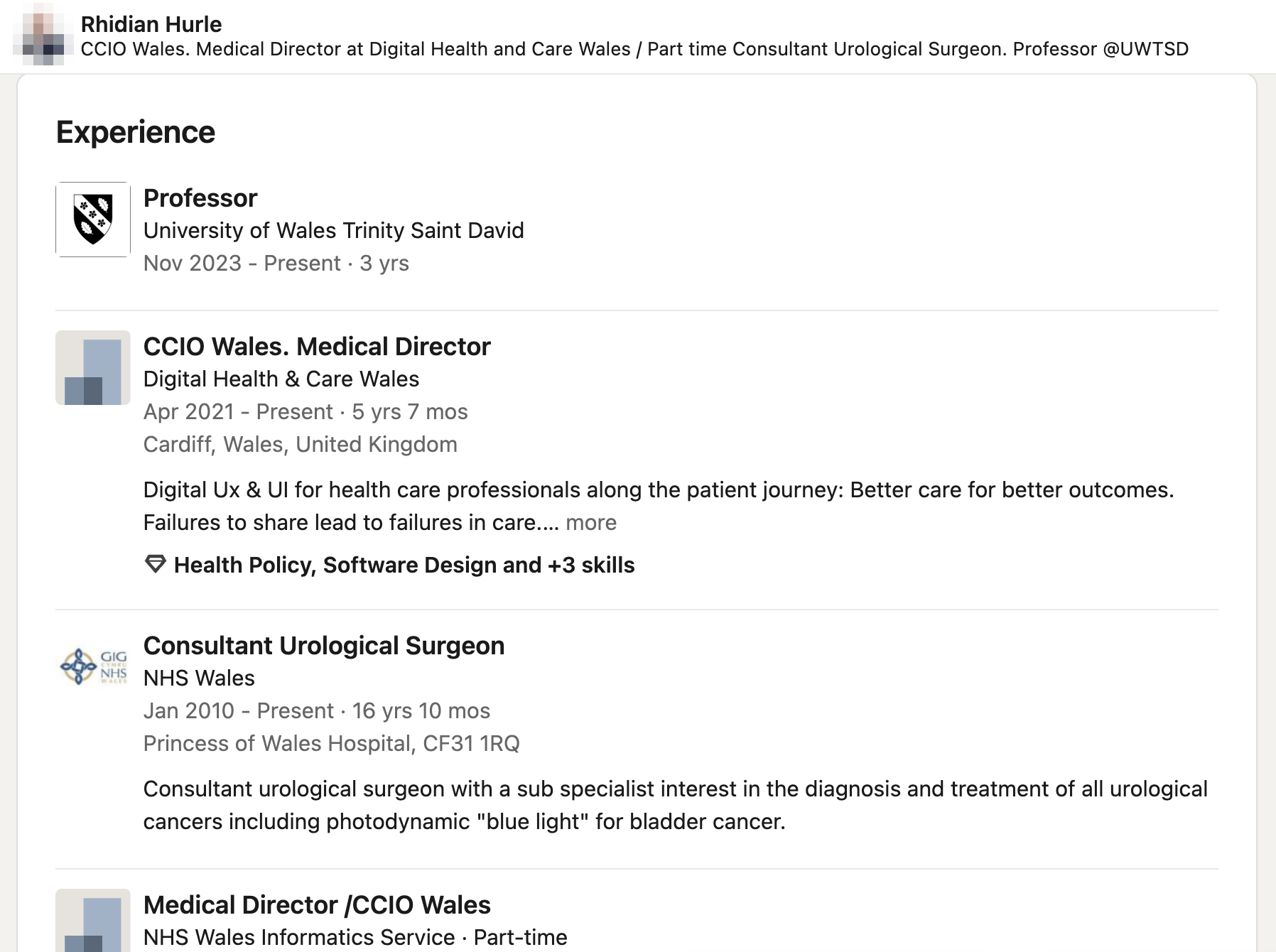
It should be said at once that Hurle is the one holder with a research doctorate: an MD from Cardiff University, where he also holds an honorary teaching post. UWTSD has said he "is already supporting the University's MSc in Digital Skills for Health and Care Professions programme." His case is the strongest of the three. It is also the one Hayter and Jackson's advice fits most exactly. To those who know the difference between an honorary and a substantive professorship "yet still continue to refer to themselves as 'professor'", they wrote: "our advice is simple; do not do it."
Helen Thomas — NWIS's Director of Information from 2017 and DHCW's chief executive since its founding — lists it under "Honors & awards". Of the three placements, that is the most accurate, since UWTSD describes the title as unpaid and voluntary. But the heading reads simply "Professor", and the details beneath it tell a different story from the university's. The entry names the issuer as "UWTSD Wales Institute of Digital Information". That is not the university's Senate and Council, which UWTSD says approve its titles; it is the partnership of which Thomas is herself a listed director. And it dates the title "Nov 2020", "Associated with Digital Health & Care Wales". In November 2020 DHCW did not exist. Thomas was interim director of NWIS, and NWIS appears nowhere on her LinkedIn profile: as The Credential Sprint has set out, her career history there jumps from ABMU in March 2017 to DHCW in January 2021. On her own public account, the title belongs to the organisation she leads now, not the one she led when she received it.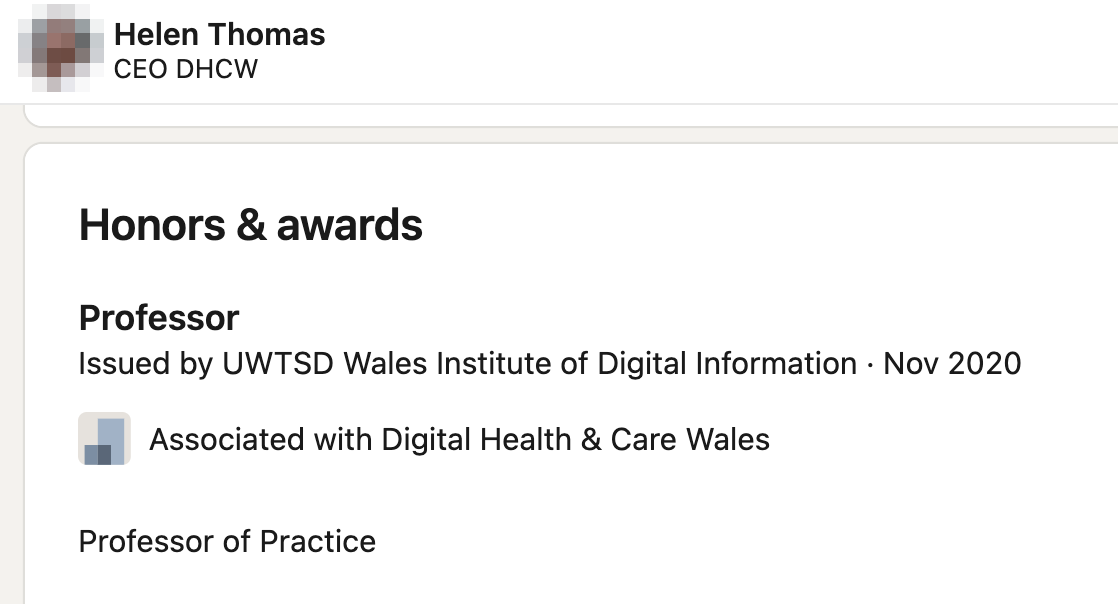
Elsewhere her board biography, like her WIDI profile, describes her as "a Professor of Practice at University of Wales Trinity St David." The same sentence appears in paragraph 1 of her witness statement to the UK COVID-19 Inquiry, INQ000226462, which is verified by a statement of truth. Through it, the title entered the record of a statutory public inquiry without the word its awarding body uses for it: honorary. In fairness, the Senedd's record of her evidence introduces her simply as "chief executive of Digital Health and Care Wales".
Ifan Evans is the most candid of the three. His entry, also under "Experience", reads "Professor of Practice" at the University of Wales Trinity Saint David, "Nov 2023 – Present", with one line of description: "Honorary Professor with UWTSD supporting the Welsh Institute for Digital Information." His headline does not mention the title, and his DHCW biography does not mention it at all.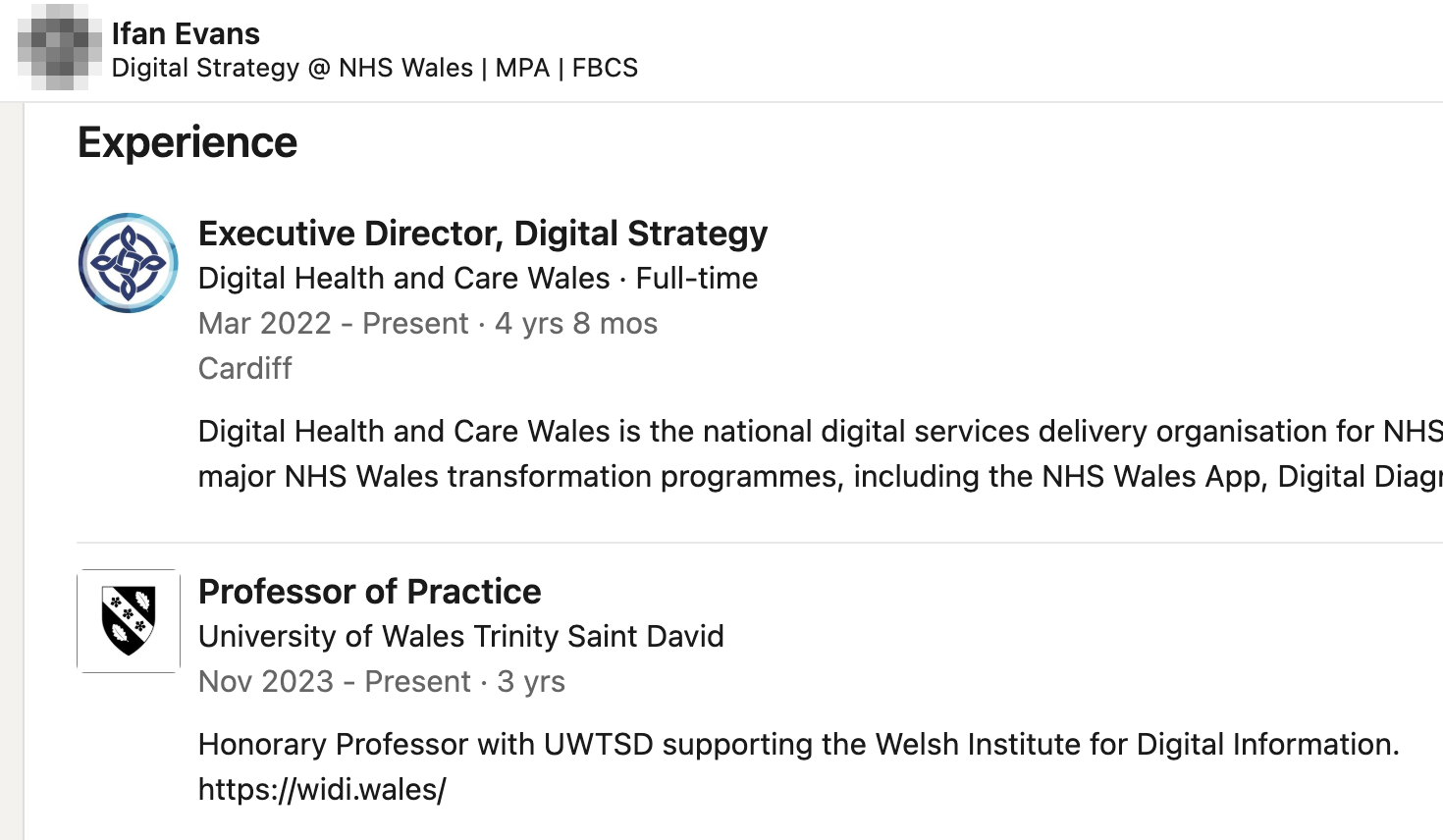
Read together, the three entries say things that DHCW's own records do not.
They date the titles. Hurle and Evans both date theirs from November 2023. UWTSD's March 2024 event presented them as "newly appointed". By their own accounts they had held the title for four months by then. November 2023 also falls in the window in which, by DHCW's own board paper, "WIDI developed a bespoke digital training programme for the top three courses in late 2023 and early 2024". Two months later, on 25 January 2024, DHCW's board was told those courses were "commencing next month".
They place the titles in the partnership. Thomas names WIDI as the issuer of hers; Evans describes his as "supporting" WIDI. Neither mentions students. WIDI is the partnership that DHCW commissioned to train its staff, of which DHCW's chief executive is a director, and which DHCW describes as a "separate agreement" from its lease with the same university. Dearing said the same thing in the university's words when she handed over the 2024 certificates: "The appointment of our Professors of Practice strengthens our partnership."
And they make the titles public. All three tell LinkedIn about the title. None has told DHCW's register of interests, where Thomas and Hurle record "Nil Declaration" and Evans lists three company directorships.
Hayter and Jackson explained why any of this matters: "the title professor probably carries more weight in civilian life than any suffix."
The standard they are held to
DHCW's directors do not have to guess what is expected of them. It is written down in three layers, and DHCW wrote two of them itself.
The first is the Seven Principles of Public Life, the Nolan Principles, which the government applies to everyone "in the health … services". Under Integrity: "They must declare and resolve any interests and relationships." Under Leadership: "Holders of public office should exhibit these principles in their own behaviour." The Welsh Government's Managing Welsh Public Money, which governs the chief executive as DHCW's Accountable Officer, adds that "every individual working for the public service in Wales has a responsibility to conduct themselves at all times in accordance with the Seven Principles of Public Life."
The second is DHCW's own. Its Standing Orders, approved by its board in March 2025, say: "It is a requirement that all Board members must declare any personal or business interests they may have which may affect, or be perceived to affect the conduct of their role as a Board member." They add: "the onus regarding declaration will reside with the individual Board member." Its Standards of Behaviour Policy, approved in January 2025, defines a conflict of interest as circumstances in which "a reasonable person would consider that an individual's ability to apply judgement or act … is, or could be, impaired or influenced by another interest they hold." Among the interests it lists as relevant is "Any other connection with a voluntary, statutory, charitable or private body that could create a potential opportunity for conflicting interests." It tells Executive Directors to "lead by example and ensure that they personally declare any relevant interest". And it settles the hard cases in one sentence: "Where there is doubt, a declaration of interest should be made."
The third is professional. Rhidian Hurle is a registered doctor. The General Medical Council's Good Medical Practice says: "You must always be honest about your experience, qualifications, and current role." A doctor facing a conflict of interest must "declare it in line with local and national arrangements." Helen Thomas and Ifan Evans are Fellows of BCS, the Chartered Institute for IT. Its Code of Conduct says: "If any conflict is likely to occur or be seen by a third party as likely to occur you will make full and immediate disclosure to your Relevant Authority", which it explains is normally the employer.
None of these rules asks whether anyone gained from an interest, and we do not suggest that any of the three did. They ask something simpler. Would a reasonable person think a professorship from the organisation's landlord and training partner could influence judgement? If in doubt, declare it. Three directors hold the title. Their entries on DHCW's register say nothing about it.
These are the standards DHCW asks the public to trust it by, and its own policy says its directors should set the example. When the people at the top do not apply the organisation's own rule to themselves, it is fair to ask what standard everyone else is being shown.
The other timeline
The titles were awarded, renewed and worn against a record that the Senedd, the Auditor General and the Welsh Government have been setting down for eight years — first about NWIS, then about the body that replaced it. The Credential Sprint sets out the chief executive's credentials against that record in full; the short version is this.
| The partnership and the titles | The delivery and oversight record |
|---|---|
| 2016–17: NWIS takes a ten-year lease in UWTSD's Technium 2; WIDI launched | January 2018: the Auditor General finds NWIS's reporting "partial and overly positive" |
| November 2018: the Senedd's Public Accounts Committee calls NWIS's culture "the antithesis" of openness and recommends a review of "the senior leadership capacity in terms of skillset" | |
| December 2020: Thomas and Griffiths named Professors of Practice; USW joins WIDI | October 2020: Audit Wales finds the prospects for the community care system WCCIS "remain uncertain" |
| April 2021: DHCW created, Thomas chief executive | |
| 2023–March 2024: Hurle and Evans titles; WIDI courses begin | July 2023: Senedd committees' joint scrutiny of DHCW makes 14 recommendations |
| November 2024: WIDI commissioned for AI module; talks with the Technium landlord | March 2025: escalated from Level 1 straight to Level 3 over "serious concerns about the organisation's ability to effectively deliver a number of major programmes" |
| February 2026: Technium 2 lease renewal approved | February 2026: the Cabinet Secretary tells DHCW to alert Welsh Government earlier, "avoiding the pattern of late notification that undermines system confidence" |
| April 2026: Level 4; the framework, published in July, cites "insufficient delivery grip and realism in leadership behaviours" and finds that "Cultural factors appear to inhibit early, open reporting of delivery risk" | |
| July 2026: UWTSD confirms the three titles renewed | August 2026: Audit Wales finds the board "cannot track progress, costs, and benefits closely" |
On the day DHCW was escalated, Lee Waters MS told the Senedd that "the previous body, which is basically the same body with a different name … was guilty of a pattern of being overly positive in reporting its progress", and that "There's something not right and not working well." (Senedd, 11 March 2025)
What would fix it
None of the remedies is new, and none is CareNHS's invention. They come from the academics quoted above and from the institutions' own rules.
- Decide titles in the open. A Senate or Council decision against published criteria, with a minute anyone can find (Palfreyman; UWTSD's own internal review says this is how it is done).
- Say "honorary". In biographies, board papers, witness statements and signatures — as Hayter and Jackson, UCLan and St Andrews all urge, and as UWTSD's own name for its framework already does.
- Declare it or do not use it. A title, a directorship of a partner body, a landlord relationship: each belongs on the register while the holder sits on the board.
- Publish the framework. UWTSD should publish its 2025 Honorary Professor of Practice Framework and the Institute Board reviews its Handbook required.
- Publish the agreements. DHCW should publish the WIDI agreement, what it has paid UWTSD and WIDI for training, and any conflict assessment carried out on the Technium 2 lease and its renewal — and act on its own internal auditor's recommendation to put procurement-related declarations on a public register.
- Disclose by influence, not just office. A related-party note that lists two universities because two independent members sit on their councils, but not the university that is the organisation's landlord, training partner and the awarding body of three directors' titles, is following the letter of the standard and missing its point.
The answer in one word
At the event in December 2020, UWTSD's Vice-Chancellor, Medwin Hughes, said: "Our students will benefit greatly from their expertise and experience." NWIS's news story the next day quoted Helen Thomas: "I am looking forward to being able to share some of my experience with the students as they embark on their education in health informatics."
Five and a half years later, asked what had happened, the university said it did not have the data; then that it held the data; then, again, that it did not. It said it had no records of any academic activity by any Professor of Practice. It would not show the framework that set out what the title required.
Asked whether, after all that, the titles had been renewed, it needed one word.
"Yes."
The documents
- UWTSD, Major boost to Wales' healthcare workforce development and research, 9 December 2020 — the WIDI memorandum, the titles, and the SA1 relocation sentence.
- WIDI, Professor Wendy Dearing — her NWIS role and appointment to head UWTSD's Institute of Management and Health; UWTSD's announcement, 17 September 2020; DHCW (archived NWIS news), Celebrating a digital workforce partnership — Dearing as NWIS Head of Workforce and UWTSD Professor of Practice; University of Brighton, Alumna Wendy Dearing's story, 17 March 2021; BCS, Informatics and the case for professionalism — FEDIP Leading Practitioner.
- DHCW (archived NWIS news), Andrew Griffiths named new chief executive of FEDIP — Griffiths as NWIS's former director; Dearing quoted as a FedIP board member.
- DHCW (archived NWIS news), Helen Thomas, NWIS interim CEO, named Professor of Practice, 10 December 2020.
- UWTSD, Institute event explores opportunities and challenges in higher education provision, March 2024 — the Hurle and Evans certificates.
- UWTSD, Ordinances (November 2022) and Honorary Awards Criteria and Procedure (2022); Academic Quality Handbook 2023-24.
- WhatDoTheyKnow: obligations and activities (including the 17 June 2026 section 12 letter); roster and governance; financial relationship (F26-067).
- DHCW, response to FOI/6781535 on premises and leases, 15 May 2026 — Technium 2 landlord, rent, lease dates and the "two separate agreements" answer.
- DHCW board, Strategic Workforce Planning report, 26 September 2024.
- DHCW public board meeting recordings: 1 April 2021, 27 May 2021, 29 July 2021, 24 November 2022, 25 January 2024, 26 September 2024, 28 November 2024, 27 March 2025, 29 September 2025, 2 February 2026, 30 July 2026, and every scheduled meeting between.
- DHCW annual reports 2024-25 and 2025-26 (Note 30); 2023-24.
- DHCW, registers of interest, October 2025 and April 2026; internal audit of declarations of interest, August 2024.
- Audit Wales, Structured Assessment 2024; Digital Health and Care Wales – Digital Transformation, published 3 August 2026.
- Welsh Government, DHCW oversight and escalation framework, May 2026, published 9 July 2026.
- UK COVID-19 Inquiry, witness statement of Helen Thomas, INQ000226462.
- Committee on Standards in Public Life, The Seven Principles of Public Life; Welsh Government, Managing Welsh Public Money.
- DHCW, Standing Orders, approved 27 March 2025 (section 8, Values and Standards of Behaviour); DHCW, Standards of Behaviour Policy (CG-POL-19), approved January 2025, via DHCW corporate governance policies.
- General Medical Council, Good Medical Practice (2024), Domain 4; BCS, Code of Conduct (2022).
- LinkedIn profiles of Helen Thomas, Rhidian Hurle and Ifan Evans, as viewed 5 October 2026 (copies held by CareNHS).
- Senedd Public Accounts Committee, Informatics Systems in NHS Wales, November 2018; Auditor General for Wales, Informatics systems in NHS Wales, January 2018.
- Hayter and Jackson, Misunderstanding or misrepresentation? The use and misuse of the professorial title in nursing, Journal of Clinical Nursing, 2020.
Related pages
- The Credential Sprint — the chief executive's credentials against the delivery record
- Accountability as Alibi — the undeclared professorships inside the governance machine
- Every AI Success in NHS Wales Has One Thing in Common — the WIDI AI training module
- The Verdict Nobody Reported — the Level 4 framework
CareNHS invites responses from Digital Health and Care Wales, Helen Thomas, Rhidian Hurle, Ifan Evans, the University of Wales Trinity Saint David, Professor Wendy Dearing and Andrew Griffiths on the matters in this article that concern each of them. If received, we will publish them in full.
Last reviewed: